
NRL Archetypes: Understanding Player Roles Beyond Position
Modern rugby league analysis needs more than traditional position labels. A fullback, winger, half, or middle forward tells us where a player lines up, but not how they actually influence a match. That is where NRL archetypes become useful.
An archetype groups players by playing style. Instead of asking only whether someone is a centre or a second-rower, archetypes ask a sharper question: what kind of centre or second-rower are they?
Some players create tries. Some bend the defensive line. Some win metres through repeated carries. Others contribute through passing, kicking, defensive workload, or support play. By analysing statistical patterns, we can separate players into meaningful role profiles that better reflect what they do on the field.
Why Archetypes Matter
Traditional rugby league positions are broad. Two players may both wear the same jersey number but play very different roles.
One fullback might operate as an extra playmaker, linking with halves and creating tries through passing. Another might be a ball-running threat who breaks tackles and attacks broken defensive lines. A third might be a high-workrate fullback who generates metres, supports through the middle, and constantly involves himself in yardage sets.
Calling all three simply “fullbacks” misses the point.
Archetypes make player comparison fairer and more useful. They allow fans, analysts, coaches, and recruitment teams to compare players with similar responsibilities rather than forcing every player in a position into one ranking.
The Main NRL Archetypes
Fullbacks
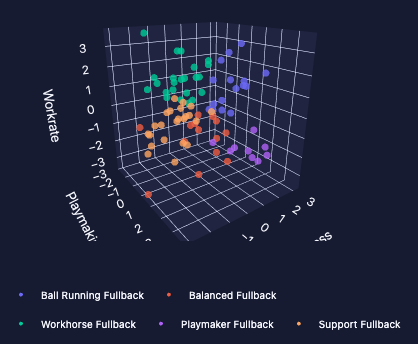
Fullbacks can be grouped into styles such as:
Playmaker Fullback
A creative fullback who contributes heavily through try assists, line break assists, and passing involvement.
Ball Running Fullback
A dangerous runner who threatens the line through tackle breaks, tries, and line breaks.
Workhorse Fullback
A high-involvement player who produces strong running metres, hit-ups, and support play.
Balanced Fullback
A complete fullback who contributes across playmaking, running threat, and workrate.
Support Fullback
A lower-involvement attacking profile, often contributing in more specialised or defensive ways.
Wingers
Wingers are often judged by tries, but their roles vary significantly.
Finisher Winger
A winger who excels at converting opportunities into tries and line breaks.
Workhorse Winger
A winger who does heavy yardage work, wins metres, and takes tough carries out of trouble.
Support Winger
A lower-involvement winger who may have fewer attacking touches or a more limited role within the team structure.
Centres
Centres sit between power running and creative link play.
Link Centre
A centre with strong passing involvement who can act almost like an extra five-eighth on an edge.
Strike Centre
A try-scoring and line-breaking threat who is dangerous close to the line.
Workhorse Centre
A centre who contributes heavily through carries, metres, tackle breaks, and repeated involvement.
Support Centre
A lower-usage centre who may play a more limited attacking role.
Halves
Halves can look very different depending on whether they dominate the ball, run the ball, or organise structure.
Dominant Half
A primary playmaker who controls attack, creates tries, and handles much of the kicking responsibility.
Running Half
A half who threatens the defensive line through carries, tackle breaks, and running metres.
Organising Half
A more structure-focused half who may support a dominant partner and guide an edge.
Hookers
Hookers are no longer just passers from dummy half. Their archetypes show how varied the role has become.
Running Hooker
A hooker who attacks from dummy half and generates metres through carries.
Link Hooker
A pass-first hooker who connects forwards and halves through distribution.
Crafty Hooker
A creative hooker who contributes through assists and attacking deception.
Balanced Hooker
A hooker who blends running, passing, and creativity.
Edge Forwards
Second-rowers are often split between strike runners, metre-eaters, and defensive specialists.
Strike Attacking Edge
A line-running edge forward who scores tries and breaks the line.
Strong Attacking Edge
A powerful carrier who wins contact and generates metres.
Defensive Enforcer Edge
A defensively focused edge forward with high tackling output and reliability.
Support Edge
A lower-involvement profile that may play a more limited or specialised role.
Middles
Middle forwards vary between ball-playing locks, impact runners, and traditional workload forwards.
Ball Playing Middle
A forward who passes, links play, and contributes creatively through the middle.
Impact Middle
A powerful ball-runner who bends the line through metres, post-contact metres, tackle breaks, and offloads.
Standard Middle
A reliable middle who shares the core running and defensive workload.
How Archetypes Are Built
Archetypes are created by analysing groups of statistics that describe different parts of a player’s game.
For example, a fullback’s profile might consider:
Playmaking: try assists, line break assists, passes
Running threat: line breaks, tries, tackle breaks
Workrate: run metres, hit-ups, post-contact metres
Players are then grouped according to similar statistical patterns. This produces clusters of players who perform similar roles, even if they are not identical players.
The result is not meant to replace watching games. Instead, it gives structure to what we see. It turns vague descriptions like “he’s more of a runner” or “he plays like another half” into measurable categories.
What Makes This Useful
Archetypes are useful because they improve context.
A winger with fewer tries might still be valuable if he is carrying a huge yardage load. A half with fewer running metres might still be elite if he controls kicking and creates chances. A middle forward with fewer hit-ups might be important because he acts as a ball-playing link.
Without archetypes, players are often compared against the wrong expectations. With archetypes, the question becomes more precise: is this player effective for the role he actually plays?
The Future of NRL Player Analysis
As rugby league becomes more tactical and data-driven, simple labels will become less useful. Positions still matter, but roles matter more.
NRL archetypes help explain the game in a way that is both statistical and intuitive. They show why two players in the same position can have completely different value. They also help identify underrated contributors, role specialists, and players whose impact is hidden by traditional box-score numbers.
The best analysis does not just ask who is better. It asks what a player is being asked to do, how well he does it, and which other players operate in a similar way.
That is the value of NRL archetypes: they make rugby league roles clearer, comparisons fairer, and player evaluation smarter.